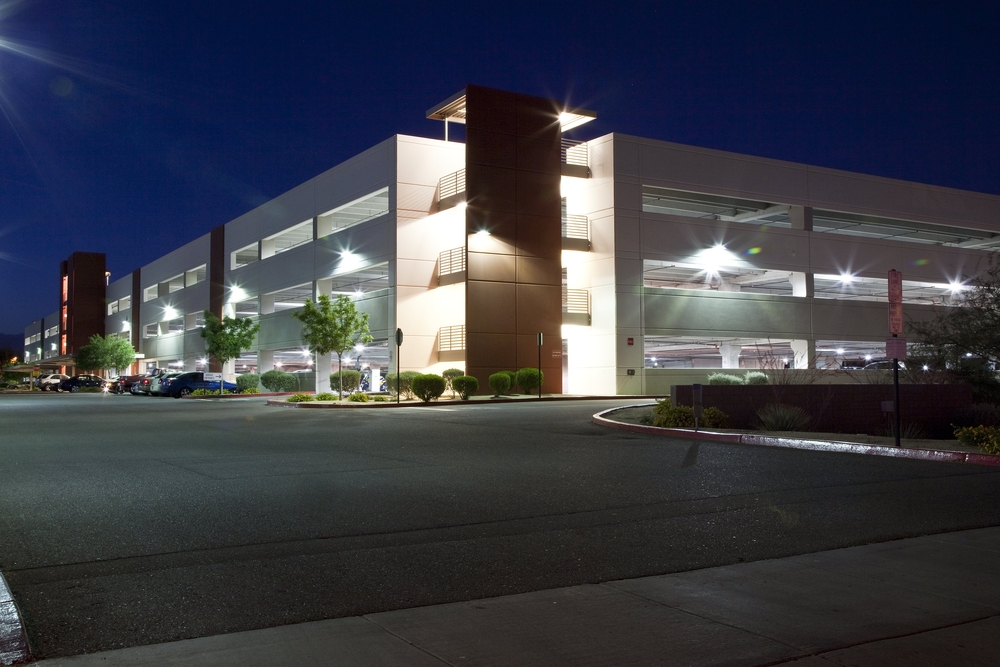
There are three common construction types for parking structures:
Cast-In-Place Concrete, Precast Concrete, and Structural Steel. As seen
in the graph, Cast-In-Place represents a higher initial cost with lower
maintenance costs, while structural steel represents a lower initial
cost with higher maintenance costs. Precast concrete falls in between in
both maintenance and initial costs.
Cast-In-Place Parking Structures
Parking structures made from Cast-in-Place are formed and poured in
place, allowing for flexible geometry of the structure. Their monolithic
design leads to fewer joints where deficiencies can arise. This leads
to reduced maintenance costs, longer life expectancy, and overall higher
durability.
Precast Parking Structures
Precast parking structures require a lower initial investment than
Cast-in-Place concrete structures, and are fabricated in a controlled
plant that is not dependent on weather. This leads to a faster and more
affordable construction schedule.
However, precast parking structures, while presenting a lower initial
cost as compared to Cast-in-Place concrete parking structures, also
present some disadvantages. The potential lack of a local plant may
present construction delays, and the specific nature of the
prefabricated concrete members lead to less flexibility in the geometric
design of the structure. Additionally, more joints in the construction
may leave the structure open to deficiencies and thermal
expansion/contraction.
Steel Parking Structures
Steel Parking Structures present a far lower initial cost and
accelerated construction schedule as opposed to concrete structures, but
the nature of the steel members can lead to corrosion/rusting issues,
and therefore higher maintenance costs. Additionally, this type of deck
is not suited for fire protection.
Many see the outwardly rugged nature of a Parking Structure and
assume that they are indestructible and require little maintenance.
Unfortunately, this is simply not true. Many parking structures lack a
true building envelope, and instead leave their structural components
exposed to the elements. This leads to deterioration before construction
has even completed. This deterioration is often ignored until a
critical failure has occurred, resulting in much higher maintenance
costs and risk of property damage, injury, or even death.
Read more on our website!